Solar Knowledge & Insights
Battery Storage vs Net Metering: Which Solar System Should You Choose?
On this page
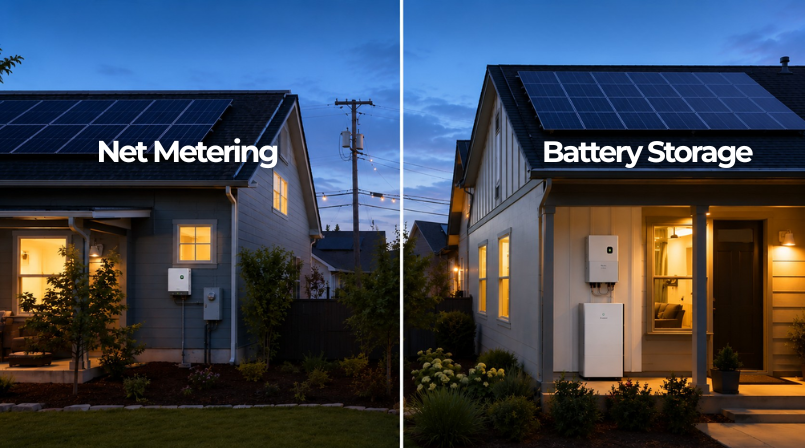
Every rooftop solar buyer eventually runs into this decision, even if they don't realize it's a decision at first: do you rely on the grid to bank your excess solar generation, or do you store it yourself in a battery? These are two fundamentally different ways of handling the same basic problem, solar panels generate power when the sun's out, but you don't always consume it then. This guide breaks down how each approach actually works and which one fits different situations.
How Net Metering Works
Net metering is essentially the grid acting as your battery. Your solar system generates during the day, and any excess beyond what you're consuming gets exported to the grid, credited against your bill. At night or on cloudy days, you draw power back from the grid, offset by the credits you built up earlier.
This is what a standard on-grid (non-hybrid) inverter setup relies on, no battery hardware, lower upfront cost, and it works well as long as your local DISCOM's net metering policy is favourable and the grid supply itself is reasonably reliable.
How Battery Storage Works
Battery storage keeps the excess solar generation on-site instead of exporting it. A hybrid inverter charges a connected battery during the day, and that stored power discharges to your loads in the evening, at night, or during a grid outage, no dependence on the grid to "give back" your exported energy.
This is a fundamentally different value proposition than net metering: it's not really about maximizing bill credits, it's about energy independence and backup power. Nothing you store gets exported or credited, it's used directly at your site.
Battery Storage vs Net Metering: The Core Trade-offs
Parameters | Net Metering | Battery Storage |
|---|---|---|
Upfront cost | Lower, no battery hardware | Higher, battery adds significant cost |
Works during a power outage | No, on-grid systems shut down for safety | Yes, battery keeps critical loads running |
Depends on | Grid reliability and DISCOM net metering policy | Your own stored capacity, independent of grid policy |
Best economic case | Stable grid, favourable net metering rates | Frequent outages, or time-of-day tariffs worth arbitraging |
System complexity | Simpler, fewer components | More complex, battery sizing and management involved |
Neither option is universally "better." Net metering makes more financial sense where the grid is reliable and the policy is favourable. Battery storage earns its added cost specifically where outages are frequent, tariffs are time-sensitive, or backup power genuinely matters to the buyer.
When Net Metering Makes More Sense
Your area has generally stable grid supply with infrequent outages
Your DISCOM's net metering policy offers a reasonable credit rate for exported power
You want the lowest upfront cost path into solar
Backup power during an outage isn't a priority for your household or business
When Battery Storage Makes More Sense
Your area experiences frequent or unpredictable power cuts
You're on a time-of-day tariff structure where shifting consumption to stored solar power during peak hours saves real money
You have loads that genuinely can't tolerate downtime, medical equipment, work-from-home setups, refrigeration, production lines
Net metering policy in your area is unfavourable, capped, or unavailable for your project type
Can You Combine Both?
Yes, and many hybrid systems effectively do. A hybrid inverter can still export excess solar to the grid under net metering when the battery is fully charged, giving you the outage protection of storage alongside whatever credit your local policy still allows for surplus generation. The two aren't mutually exclusive, the decision is really about how much of the system's value you want coming from grid credits versus from on-site storage.
Making the Right Choice for Your Project
A few practical questions to work through before deciding:
How often does your area actually lose power? If it's rare, battery storage's backup value drops significantly
What does your local net metering policy actually pay for exported power? A weak credit rate makes battery storage relatively more attractive
Is there a specific load you need to protect during an outage? If yes, that alone can justify the added cost of a hybrid system
What's your budget for the initial installation? Net metering-only systems are meaningfully cheaper to install
Summary
Net metering and battery storage solve the same underlying problem, using solar power when the sun isn't shining, in two different ways. Net metering leans on the grid and favourable policy; battery storage leans on your own stored capacity and adds real backup value. The right choice depends on your grid reliability, local policy terms, and how much you actually need power to keep running during an outage, not on which option sounds more advanced.
Not sure which fits your situation? Get in touch with OSG Oriana's Solis team to talk through on-grid versus hybrid options for your specific project.
Related Articles
Solis Single Phase Hybrid Residential Inverter if you're leaning toward battery storage for a single-phase home
Solis Three Phase Hybrid Residential Inverter for larger homes on three-phase supply considering battery backup
Solis Residential Inverters for Homes if a simpler net-metering-only system fits better
Solis On-Grid C&I Inverters for commercial and industrial net-metering setups
Solis C&I Hybrid Inverters for commercial and industrial battery storage setups
FAQs
1. Is battery storage better than net metering?
Neither is universally better. Net metering is simpler and cheaper where grid supply is reliable; battery storage is worth the added cost where outages are frequent or backup power matters.
2. Can I add battery storage later if I start with net metering only?
It depends on your inverter. A standard on-grid inverter typically can't add battery storage later without replacing it with a hybrid unit, so it's worth deciding upfront if there's a realistic chance you'll want backup later.
3. Does net metering work during a power outage?
No. Standard on-grid, net-metered systems shut down during a grid outage for safety reasons, they can't keep supplying power independently.
4. Do hybrid systems with battery storage still get net metering credit?
Often yes, once the battery is fully charged, excess solar can still export to the grid under net metering, depending on your local DISCOM's policy.
5. Which is cheaper, net metering or battery storage?
Net metering-only systems are cheaper upfront, since there's no battery hardware involved. Battery storage adds meaningful cost but delivers backup power that net metering alone can't provide.
Found this useful? Share it with your network.