Solar News And Policies
Floating Solar Power Plants in India
India crossed 150 GW of total installed solar capacity in March 2026, becoming the third largest renewable energy nation in the world. Yet floating solar power plants in India tell a starkly different story less than 700 MW commissioned against a theoretical potential of 280 to 300 GW sitting on the country's reservoirs. That gap is now squarely in the government's crosshairs.
What Is Floating Solar and How Does It Work?
Floating solar, or floating photovoltaic (FPV), involves mounting solar panels on structures that float on the surface of reservoirs, lakes, irrigation ponds, and dam backwaters. The panels generate electricity from sunlight exactly like any conventional solar installation, but the platform beneath them floats on water rather than resting on land.
The floating structure is built from high-density polyethylene (HDPE) pontoons UV-resistant, corrosion-proof, and engineered to handle prolonged exposure to sun, wind, and water. A mooring and anchoring system tethers the entire array to the reservoir bed using high-strength cables and concrete anchors, keeping it stable while still allowing the structure to rise and fall naturally with changing water levels.
Electricity generated as direct current travels through waterproof cables to onshore inverters, gets converted to alternating current, and feeds into the grid. Newer projects now integrate battery energy storage systems (BESS) directly alongside the floating array, allowing surplus daytime solar power to be stored and dispatched during evening peak demand hours.
Why India Needs Floating Solar
Land is India's most contested renewable energy resource. Every large ground-mounted solar project competes with agriculture, housing, and forestry. Floating solar power plants in India sidestep this problem entirely by using water bodies that are already government-managed.
According to research by The Energy and Resources Institute (TERI), India's reservoirs cover around 18,000 square kilometres enough to theoretically support 280 GW of floating solar capacity. JMK Research estimates the number at 300 GW when broader water bodies in states like Kerala, Assam, Odisha, and West Bengal are factored in.
Beyond saving land, floating solar delivers a measurable performance advantage. Water acts as a natural coolant for the panels, boosting efficiency by 5 to 15 percent compared to ground-mounted installations under similar conditions. Floating arrays also reduce reservoir evaporation by shading the water surface. NTPC's Simhadri plant in Andhra Pradesh alone is estimated to save 1,364 million litres of water annually through this effect a meaningful benefit in a water-stressed country.
Major Operational Floating Solar Power Plants in India
Omkareshwar Floating Solar Power Park, Madhya Pradesh 600 MW (Partial)
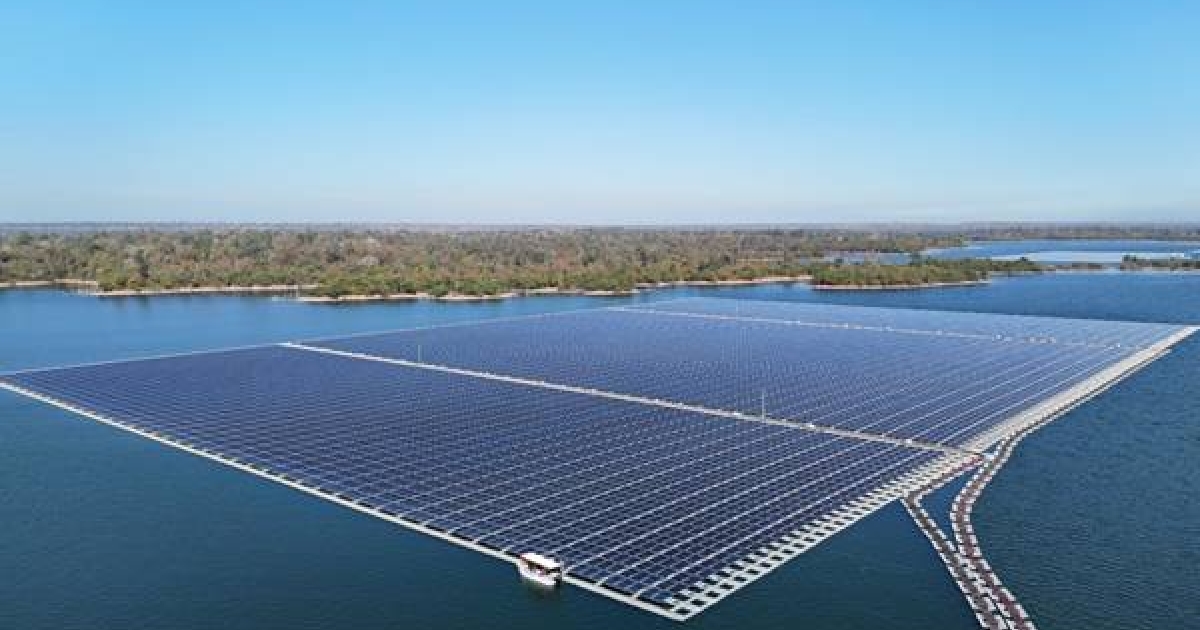
Located at Khandwa on the Omkareshwar Dam reservoir on the Narmada River, this is India's largest floating solar installation. Developed by AMP Energy, NHDC, SJVN, and Rewa Ultra Mega Solar Limited, 278 MW was activated by August 2023. Tata Power Renewable Energy commissioned a further 126 MW in November 2024 under a Rs 596 crore EPC contract, taking operational capacity beyond 400 MW. Full 600 MW commissioning is ongoing and the project, once complete, is expected to rank among the largest floating solar parks in the world.
NTPC Ramagundam, Telangana 100 MW

Spread across 500 acres on the balancing reservoir of NTPC's Ramagundam thermal station in Peddapalli district, this plant became fully operational on July 1, 2022. Built by BHEL at Rs 423 crore, it consists of 40 blocks of 2.5 MW each, with inverters and transformers mounted on floating ferrocement platforms keeping all critical electrical equipment on water alongside the panels rather than on a fixed onshore structure.
Tata Power Solar Kayamkulam, Kerala 101.6 MW
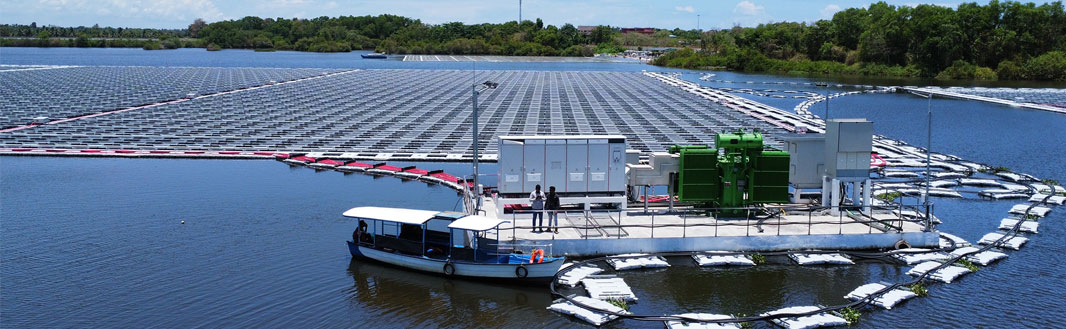
Commissioned on June 24, 2022, this was India's largest operational floating solar project at the time. It generates approximately 167,150 MWh annually and prevents 64,142 tonnes of CO2 emissions each year.
4. NTPC Haripad, Kerala 92 MW

Located at Choolatheruvu, Haripad, Alappuzha district, on reservoirs of NTPC's Rajiv Gandhi Combined Cycle Power Plant. Commissioned in phases between March and June 2022 and inaugurated by Prime Minister Narendra Modi in July 2022. Kerala State Electricity Board purchases power from the plant at approximately Rs 3.20 per kWh.
NTPC Simhadri, Andhra Pradesh 25 MW
/saur-energy/media/post_attachments/2017/12/floating-solar-power-plant.jpg)
On the reservoir of NTPC's Simhadri Super Thermal Power Station in Visakhapatnam, this was among India's earliest large floating solar projects. Fully commissioned in August 2021 and the first floating solar plant developed under India's Flexibilisation Scheme of 2018.
Projects in the Pipeline
NHPC is building one of the most ambitious FPV pipelines in the sector, including a 300 MW project on Odisha's Rengali reservoir, a 50 MW plant at West Kallada in Kerala, and over 2 GW of additional capacity across Andhra Pradesh, Bihar, and Odisha targeted by 2027.
The Policy Push That Could Change the Scale
In May 2026, the Finance Ministry's Expenditure Finance Committee approved a Rs 5,500 crore scheme to fund floating solar power plants in India paired with battery energy storage systems, with Union Cabinet approval pending. The scheme incentivises states to identify suitable water bodies and deploy integrated FPV-plus-storage projects, targeting grid reliability alongside generation growth.
In February 2026, MNRE had already directed states and union territories to map their reservoirs for FPV development, with the National Institute of Solar Energy and IIT Roorkee preparing both a national floating solar potential assessment and a draft policy framework. Odisha and Kerala have issued state-level FPV guidelines, while Madhya Pradesh and Uttar Pradesh have incorporated floating solar provisions into their renewable energy policies.
Floating solar power plants in India have already proved the technology works at scale. With dedicated central funding moving through cabinet and state-level policy frameworks now in place, the sector finally has the conditions needed to bridge the gap between potential and reality.
FAQs
Q1: Which is the largest floating solar plant in India?
Omkareshwar Floating Solar Power Park in Khandwa, Madhya Pradesh, with a planned capacity of 600 MW on the Narmada River reservoir.
Q2 : How much floating solar has India installed so far?
Less than 700 MW as of early 2026, against a theoretical potential of 280 to 300 GW sitting across India's reservoirs and water bodies.
Q3 : Which states have operational floating solar plants in India?
Madhya Pradesh, Telangana, Kerala, and Andhra Pradesh are the four states with major operational floating solar installations as of 2026.
Q4 : What is the ₹5,500 crore floating solar scheme 2026?
A central government scheme approved in May 2026 to fund floating solar projects paired with battery storage across India, currently awaiting Union Cabinet approval.
Found this useful? Share it with your network.