Solar FRP Walkway | FiberX
GI Walkway vs FRP Walkway: Which Is Right for Your Solar Site?
On this page
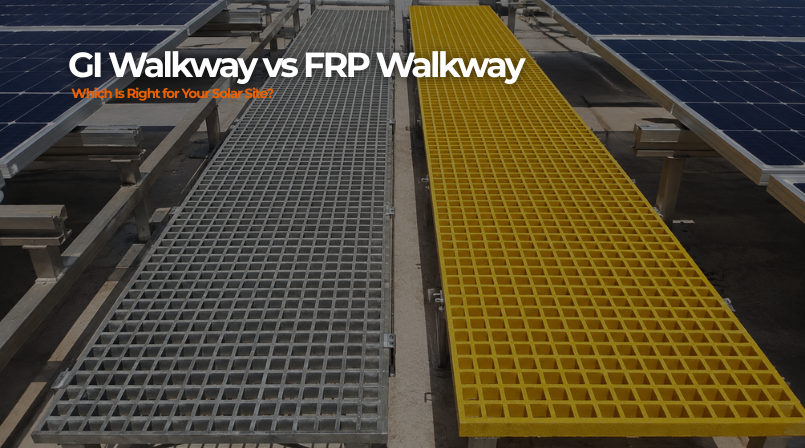
Walkway systems don't get nearly the attention inverters and panels do in a solar BOQ, but the material choice matters more than it looks on paper, especially on a site full of live DC wiring. The two real options are galvanized iron (GI) and fiberglass-reinforced plastic (FRP), and they solve the access problem in genuinely different ways.
What Is a GI Walkway
A GI walkway is a steel grating panel coated in zinc to resist corrosion, galvanization slows rusting but doesn't eliminate it long-term. It's a conventional industrial material, widely used across general industrial walkways and platforms long before solar-specific access solutions existed, and it's still specified on some sites today largely out of habit or lower upfront material cost.
What Is an FRP Walkway
An FRP walkway is a moulded or pultruded grating panel made from fiberglass and polyester resin rather than metal. It's purpose-built for exactly the kind of environment a solar site presents: live electrical equipment, prolonged outdoor UV exposure, and a need for a lightweight material that doesn't add meaningful structural load to a roof or ground-mount frame.
GI Walkway vs FRP Walkway: Head-to-Head
GI Walkway | FRP Walkway | |
|---|---|---|
Electrical conductivity | Conductive, real risk near live DC lines | Non-conductive, built for use around live electrical equipment |
Corrosion resistance | Zinc coating wears over time, especially in humid or coastal climates | Doesn't rust or corrode |
Weight | Heavier, adds structural load | Lightweight, minimal added load |
UV and weathering | Coating degrades with prolonged sun exposure | UV-stabilized, built for long-term outdoor use |
Fire behavior | Metal itself doesn't burn, but isn't the safety differentiator here | Fire-retardant material composition |
Installation | Heavier panels, more labor-intensive to handle and mount | Lighter panels, faster and easier installation |
Long-term maintenance | Re-coating or replacement needed as galvanization wears down | Effectively maintenance-free once installed |
Typical upfront cost | Often lower material cost | Higher material cost, offset by lower lifecycle cost |
Why FRP Has Become the Preferred Choice on Solar Sites Specifically
The comparison isn't close once you factor in what actually happens on a live solar installation. A GI walkway is a conductive metal surface installed near DC wiring that stays energized in daylight, that's a real electrical safety exposure a non-conductive FRP walkway simply doesn't carry. Add in a 25-year system life, where a zinc coating on steel will visibly degrade long before the solar system itself needs replacing, and the case for FRP moves from "nice to have" to "the actual right specification" for most rooftop, ground-mount, and floating solar projects.
The weight difference matters too, particularly on rooftop installations, where every additional kilogram of walkway material is additional structural load the roof has to carry for the system's entire life.
When GI Might Still Show Up
GI walkways aren't obsolete everywhere, general industrial platforms unrelated to live electrical equipment, or projects where upfront material cost is the dominant constraint and long-term maintenance is budgeted separately, may still specify it. But for a solar-specific installation, where the walkway sits near DC wiring for decades, FRP is the material actually built for the job.
Manufactured in Pune, Delivered PAN India
FRP walkway systems are manufactured by FiberX Tech Composite Pvt Ltd, based in Pune, Maharashtra, part of the Oriana India Group and under the umbrella of OSG Oriana India Pvt Ltd. Manufacturing out of Pune doesn't mean delivery is limited to Maharashtra, FiberX products reach EPCs and project sites across a PAN India network through OSG Oriana's distribution channel, the same one that supplies Solis, Sineng, and Jio Sparq inverters, and LONGi and Goldi Solar modules.
Our complete guide to FRP solar walkways covers full specifications, thickness options, and use cases across rooftop, ground-mount, and floating solar installations.
Sourcing for Your Project
OSG Oriana India Pvt Ltd distributes FiberX FRP walkway systems alongside the full Solis and Sineng inverter ranges and LONGi and Goldi Solar modules, giving EPCs a single source for a complete project BOQ, panels, inverters, cabling, and walkway access, rather than sourcing walkway material separately from a general industrial supplier.
Summary
GI walkway is a conventional industrial material carried over into solar by habit; an FRP walkway is purpose-built for the specific risks a solar site presents, live DC electrical exposure, decades of UV exposure, and structural weight sensitivity, especially on rooftops. For most solar projects, that makes FRP the more defensible specification, not just the newer one.
Specifying walkway systems for a project? Get in touch with the Oriana India Group team for FRP walkway availability and PAN India delivery.
FAQs
1. Is FRP walkway safer than GI walkway on a solar site?
Yes. FRP is non-conductive, which matters directly given the live DC wiring present on any solar installation. GI is conductive and carries real electrical risk in the same environment.
2. Does FRP walkway cost more than GI walkway?
Upfront material cost is often higher for FRP, but GI requires ongoing re-coating or replacement as its zinc coating degrades, while FRP is effectively maintenance-free over the system's life.
3. Who manufactures FRP walkways distributed by OSG Oriana India?
FiberX Tech Composite Pvt Ltd, based in Pune, Maharashtra, part of the Oriana India Group under the umbrella of OSG Oriana India Pvt Ltd.
4. Is FRP walkway available outside Maharashtra?
Yes. Despite being manufactured in Pune, FRP walkway systems are delivered across a PAN India network through OSG Oriana's distribution channel.
5. Is GI walkway ever still appropriate for a solar project?
It's less common for solar-specific installations given the electrical safety and corrosion concerns, but may still appear on general industrial platforms unrelated to live electrical equipment.
Found this useful? Share it with your network.