Solar Knowledge & Insights
How Industries Reduce Electricity Bills with Solar
On this page
- Why Industrial Power Costs Keep Climbing
- How Solar Actually Lowers the Bill
- The Equipment Decision That Determines Real Savings
- Getting Started: What an Industrial Solar Rollout Looks Like
- Solar Products Supplier/Distributor PAN India
- Solar Modules: LONGi & Goldi
- Solar Inverters: Solis & Sineng
- Solar Cables: APAR
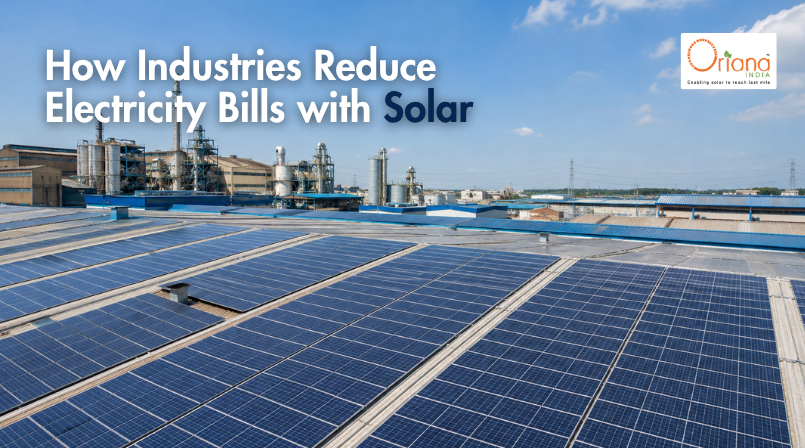
Industrial electricity bills rarely stay flat. Tariffs rise almost every year, demand charges punish peak usage, and grid outages force many facilities to run costly diesel backup on top of their regular power spend. Solar changes that equation directly not as a future plan, but as a working cost lever available today, provided the right equipment is sourced from serious Solar Products Suppliers PAN India.
Why Industrial Power Costs Keep Climbing
Most industrial and commercial tariffs are structured to punish exactly the pattern factories run on: heavy daytime consumption, seasonal peaks, and demand spikes when multiple machines start at once. On top of the per-unit rate, many states layer in demand charges, power factor penalties, and fuel surcharges that rarely move in the consumer's favor. For a facility running two or three shifts, this adds up to a bill that grows year over year regardless of how efficiently the plant itself operates.
How Solar Actually Lowers the Bill
A correctly sized rooftop or ground-mounted solar system attacks the bill from three angles at once. First, it offsets daytime grid consumption directly the hours industrial load is usually highest are also peak solar generation hours, so the biggest chunk of consumption gets covered first.
Second, hybrid systems with battery storage extend that offset into peak-tariff evening hours through peak shaving, discharging stored solar power exactly when grid rates are most expensive. Third, solar with backup removes or reduces dependency on diesel generators during outages, cutting one of the most expensive per-unit power sources a facility uses.
None of this works well with undersized or mismatched equipment. An inverter that can't handle a facility's real load profile, or panels chosen purely on lowest price, tend to underperform within a few years which is why the equipment sourcing decision matters as much as the decision to go solar in the first place.
The Equipment Decision That Determines Real Savings
Panel efficiency, inverter reliability, and cable quality directly decide how much of that theoretical savings actually shows up on the bill. A high-efficiency module from a certified manufacturer generates more energy per square foot of roof space than a budget panel of the same rated wattage.
A well-built inverter holds its efficiency rating for years instead of degrading. Cables rated for outdoor solar duty resist the heat and UV exposure that cause failures in generic wiring. This is exactly where working with established Solar Products Suppliers PAN India rather than assembling a system from whichever local vendor is cheapest that month protects the return on investment over the system's 20+ year life.
Getting Started: What an Industrial Solar Rollout Looks Like
Moving from "interested" to "installed" usually follows a predictable sequence, regardless of facility size:
Load and site audit actual consumption data and available roof or ground space, not assumptions, decide the right system size.
Equipment selection panels, inverter type (on-grid vs. hybrid), and cabling chosen to match the load profile and budget, not just the lowest quoted price.
EPC execution installation, commissioning, and net-metering paperwork handled end-to-end so the system is live and billing correctly from day one.
Monitoring and after-sales support ongoing performance tracking and manufacturer-backed warranty support for the life of the system.
Solar Products Supplier/Distributor PAN India
OSG Oriana India supplies the full stack an industrial solar project needs, sourced directly from authorized manufacturer partnerships and delivered nationwide.
Solar Modules: LONGi & Goldi
High-efficiency panels from LONGi and Goldi Solar cover residential rooftops through utility-scale ground-mount projects, with certified performance warranties and PAN India stock availability.
Solar Inverters: Solis & Sineng
For the inverter side, Solis and Sineng cover on-grid and hybrid systems from 3kW residential setups through 125kW+ commercial and industrial installations, with genuine manufacturer warranty backing.
Solar Cables: APAR
APAR solar cables are built specifically for PV installations, rated for the heat and UV exposure that shorten the life of ordinary electrical cable on rooftop and ground-mount systems.
Together, this makes OSG Oriana one of the few genuine one-stop Solar Products Suppliers PAN India panels, inverters, and cables from a single authorized source instead of piecing a system together across multiple vendors with no shared accountability.
Talk to OSG Oriana India about sizing a solar system for your facility →
FAQs
1. How much can a factory realistically save on electricity with solar?
Savings vary by load profile and system size, but most industrial solar installations offset 40-80% of daytime grid consumption.
2. Does solar work without battery storage for industries?
Yes, grid-tied systems alone cut daytime bills significantly; battery storage adds backup and evening peak-shaving on top.
3. How long does it take for an industrial solar system to pay for itself?
Most C&I solar installations in India recover their cost in 3-5 years, depending on system size and local tariffs.
4. Is it better to buy panels, inverters, and cables from one supplier?
Yes, sourcing from one authorized distributor ensures compatible components and single-point accountability for warranty and service.
5. What size solar system does an industrial facility typically need?
Sizing depends on roof area, sanctioned load, and consumption pattern a site audit is the only reliable way to determine it.
Found this useful? Share it with your network.