Solar News & Policies
PM Surya Ghar 2.0: India's Next Rooftop Solar Upgrade
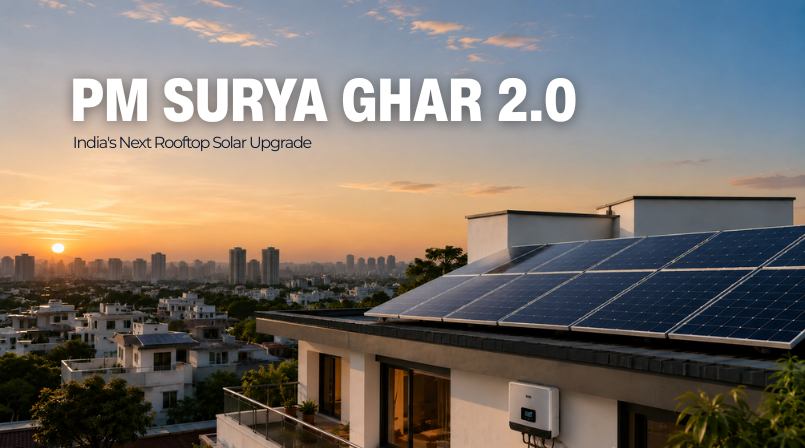
India's rooftop solar story so far has largely been about one thing: get a system installed, claim a fixed capital subsidy, and start generating power. That's how PM Surya Ghar: Muft Bijli Yojana has worked since it launched in February 2024 a flat, one-time Central Financial Assistance based on system size, capped at 3 kW.
That model has worked well enough to push the scheme past several million rooftop installations. But the government now appears ready to rethink the formula. Enter PM Surya Ghar 2.0 a proposed overhaul that could change how subsidies are calculated, bring battery storage into the picture, and open the scheme up to homes that couldn't participate before.
Here's what's being discussed, and what it could mean if you're planning a rooftop solar or hybrid system.
From "install and forget" to "perform and earn"
The biggest shift under consideration is a move away from a purely installation-based subsidy toward a model that also rewards how a system actually performs over time. The Ministry of New and Renewable Energy (MNRE) held a dedicated brainstorming session in July 2026 to map out this roadmap, bringing together officials, the International Solar Alliance, DISCOMs, think tanks, and rooftop solar developers.
What emerged from that discussion is a two-part idea for financial support: one portion as the familiar upfront capital assistance homeowners already know, and a second portion tied to real-world outcomes electricity actually generated, ongoing operation and maintenance, battery storage usage, and the grid-support value a household's system provides over its lifetime. In other words, a well-maintained, consistently producing system could be rewarded more than one that's installed and neglected.
Other ideas on the table include generation guarantees from installers, AI-assisted quality checks of rooftop installations before and after commissioning, and support levels that vary by household income, location, consumer category, and how much value a system delivers back to the grid.
Battery storage plays a central role
Right now, battery storage sits outside the subsidy if you want backup power, it's an out-of-pocket addition on top of your solar system. That's expected to change under the proposed redesign. The government is looking at both home-level battery systems and storage at the distribution network level, aimed at solving a problem rooftop solar itself has created: too much power flowing back to the grid at midday, and not enough support during evening peak demand.
For homeowners, this points toward a future where a properly configured hybrid inverter and battery setup isn't just a backup convenience it's part of a system designed to work with the grid, not just alongside it. If you're planning ahead, a Solis hybrid inverter is a practical way to build that battery-readiness into your system from day one, rather than retrofitting later.
Solar for homes without a usable rooftop
One real gap in the current scheme is that it assumes you own a rooftop suitable for panels. Apartment residents, renters, and homes with shaded or structurally limited roofs have largely been left out. The proposed redesign is expected to address this through virtual and group net metering, balcony solar units, façade-mounted (BIPV) panels, and community solar projects effectively letting more households benefit from rooftop solar economics even without a rooftop of their own.
What this means if you're planning to install a solar system
None of this is confirmed policy yet MNRE is expected to circulate a formal deliberation document before this moves toward actual guidelines. But a few things are worth acting on regardless of how PM Surya Ghar 2.0 finally shapes up:
Component quality will matter more, not less. If future support is linked to generation performance and AI-based quality checks, systems built on inferior modules or undersized inverters will fall behind on paper as well as on your electricity bill. Starting with tier-1 modules like Goldi solar panels and properly rated Solis on-grid inverters puts you ahead of that curve.
Cabling and balance-of-system components aren't a place to cut corners. Performance-linked incentives reward systems that keep generating reliably for years, and that starts with quality DC/AC cabling something APAR solar cables are built for.
If you're considering a larger or commercial-scale rooftop setup, Sineng inverters are worth evaluating for their grid-support and efficiency profile, especially as grid-interaction requirements get more attention under the proposed scheme.
Keep an eye on the official portal. All current applications, subsidy tracking, and future scheme updates will continue to run through the PM Surya Ghar national portal, so that remains the one source to check before believing any third-party claim about subsidy amounts or eligibility.
Conclusion
PM Surya Ghar 2.0 is still in the discussion-paper stage, but the direction is fairly clear: less "install once, subsidy once," and more "build a system that performs, and get rewarded for it long-term." Battery storage, hybrid inverters, and component quality are moving from optional upgrades to central pieces of how rooftop solar in India is likely to be judged and financed going forward.
If you're planning a rooftop solar or hybrid system and want it built to hold up under whatever PM Surya Ghar 2.0 eventually requires, OSG Oriana India can help you put together the right combination of panels, inverters, and cabling reach out to explore Solis, Sineng, Goldi modules, and APAR cables for your next project.
Found this useful? Share it with your network.