General
Rooftop Solar vs Ground Mounted Solar: Which Should You Choose?
On this page
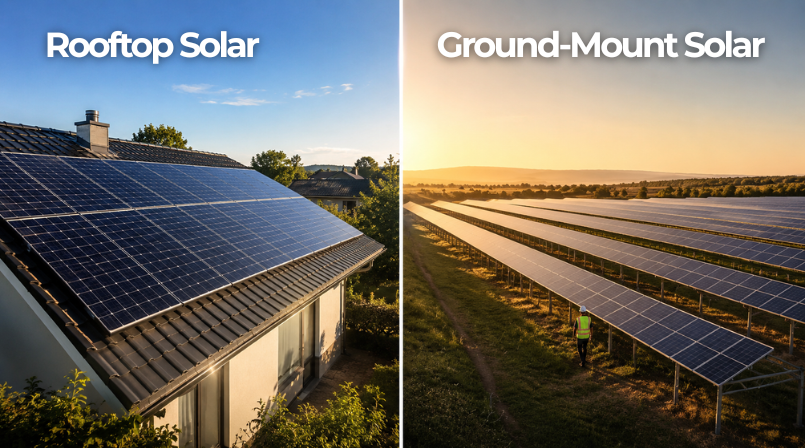
The panels look the same either way, but where you put them changes almost everything else about a solar project: cost per watt, structural requirements, maintenance access, and even which inverter makes sense. This guide breaks down rooftop versus ground-mounted solar so you're choosing based on your actual site and goals, not just whichever option your installer mentioned first.
Rooftop Solar: Pros and Cons
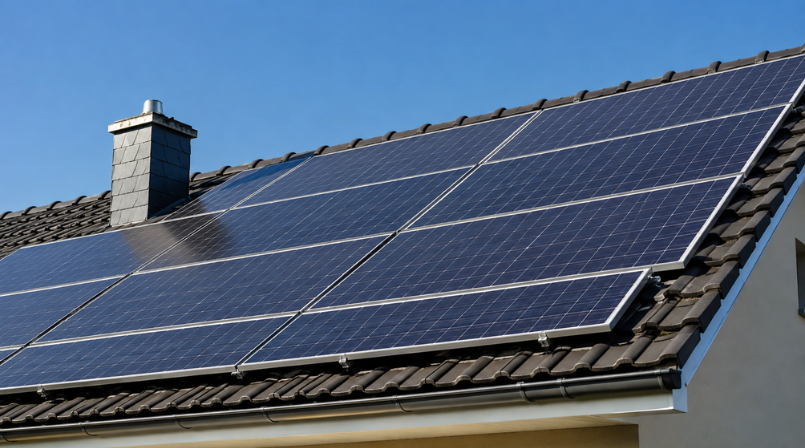
Rooftop systems use existing structure, no new land, no separate civil work for mounting, which is why they dominate the residential and small commercial segment.
Advantages:
Uses space you already have, no additional land cost or acquisition
Generally lower installation cost than ground-mount at the same capacity, since mounting is simpler
Closer to the point of consumption, shorter cable runs, lower transmission loss
Common enough that most installers and inverter brands are well set up to support it
Limitations:
Roof area caps your maximum system size, you can't just add more capacity if you run out of usable roof
Roof orientation, shading from nearby structures, and structural load capacity all constrain design
Maintenance access can be harder and riskier than a ground-level system
Older roofs may need reinforcement or even replacement before installation, adding unplanned cost
Ground-Mounted Solar: Pros and Cons
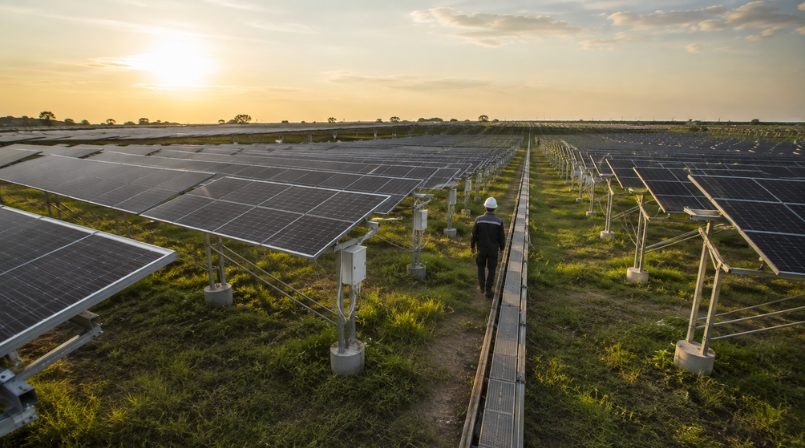
Ground-mount systems sit on dedicated land, either open fields, unused plots, or purpose-built structures, and scale differently than rooftop.
Advantages:
Not limited by roof size, capacity scales with available land, which is why utility-scale projects are almost always ground-mount
Optimal panel angle and orientation can be engineered from scratch, rather than working around an existing roof
Easier maintenance access, technicians can walk the site at ground level rather than working at height
Can incorporate tracking systems (following the sun through the day) more practically than most rooftops allow
Limitations:
Requires dedicated land, either owned or leased, which is a real cost most rooftop projects don't have
Civil work (foundations, mounting structures, fencing, access roads) adds cost and time upfront
Longer cable runs from panels to inverter to grid connection point, compared to a compact rooftop layout
Land-use and environmental clearances can apply depending on project scale and location
Key Differences That Actually Matter
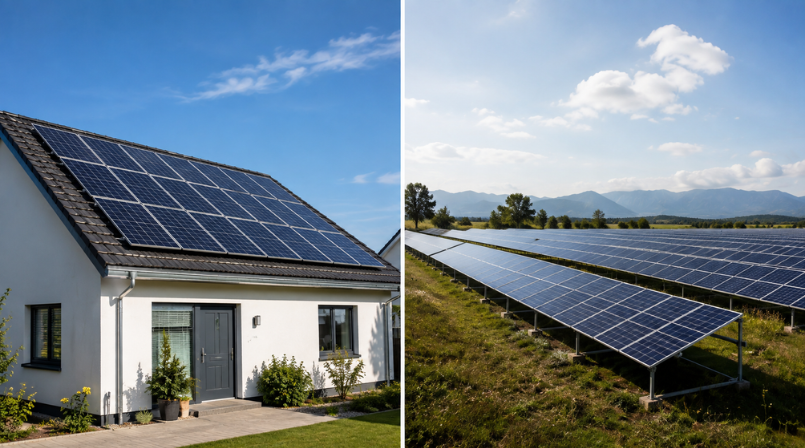
PARAMETERS | Rooftop | Ground-Mounted |
|---|---|---|
Typical scale | Residential to mid-size commercial | Large commercial to utility-scale |
Land requirement | None, uses existing structure | Dedicated land needed |
Installation complexity | Lower for standard roofs | Higher, civil work required |
Maintenance access | Can require rooftop access, sometimes at height | Ground-level, generally easier |
Design flexibility | Constrained by existing roof shape and orientation | Full control over layout and orientation |
Typical inverter class | Residential and C&I string inverters | High-power C&I and utility-scale string inverters |
Which One Should You Choose
Homeowners and small businesses with adequate roof area and no major shading issues are almost always better served by rooftop solar, lower cost, no land requirement, and inverter options built specifically for this scale
Larger commercial and industrial sites with available land, or roof area too small for the desired capacity, should seriously evaluate ground-mount, especially if there's unused land already on the property
Utility-scale developers default to ground-mount almost by definition, the capacity requirements simply don't fit on any rooftop
Sites with structurally weak or heavily shaded roofs may find ground-mount the more practical option even at a smaller commercial scale, despite the added land and civil cost
Inverter Considerations for Each
The inverter class that fits changes with the mounting type, not just the capacity:
For rooftop residential systems, see our guide to Solis residential inverters, built for the compact, single-building scale rooftop projects need
For rooftop or ground-mounted C&I systems, our guide to Solis on-grid C&I inverters covers the mid-scale range that fits either mounting type
For large ground-mount and utility-scale projects, our guide to Solis string inverters explains why string architecture, not central inverters, is what modern ground-mount plants are increasingly built on
Ground-mount sites also typically need safe walkway access between panel rows for maintenance crews, our FRP solar walkway guide covers why fiberglass walkway systems are the standard choice here
Sourcing Equipment for Either Project Type
OSG Oriana India Pvt Ltd distributes the full Solis inverter range, residential rooftop through utility-scale ground-mount, alongside LONGi and Goldi Solar modules, APAR cables, and FiberX FRP walkway systems, across a PAN India network. Whichever mounting type your project needs, the equipment can come from a single supplier.
Summary
Rooftop and ground-mounted solar solve the same basic problem, generating power from sunlight, but they fit very different situations. Rooftop wins on cost and simplicity for most residential and small commercial projects; ground-mount wins on scale and design flexibility once land is available and capacity requirements outgrow any available roof. The right choice depends on your site, not a general preference for one over the other.
Planning a rooftop or ground-mount project? Get in touch with OSG Oriana's team to discuss the right inverter and equipment for your site.
FAQs
1. Is rooftop or ground-mounted solar cheaper?
Rooftop is generally cheaper per watt at smaller scale, since it avoids land cost and civil work. Ground-mount can become more cost-effective at large scale, where roof space simply isn't an option.
2. Can I install ground-mounted solar on a small residential property?
Yes, if you have available land, though for most homes with adequate roof space, rooftop remains the simpler and lower-cost choice.
3. Do rooftop and ground-mounted systems use different inverters?
The inverter class depends more on system capacity than mounting type, but ground-mount and utility-scale projects typically use higher-power string inverters designed for larger, multi-string arrays.
4. Which option is better for maintenance?
Ground-mounted systems are generally easier to maintain, since technicians work at ground level rather than needing rooftop access.
5. Does ground-mounted solar need special approvals?
Depending on project scale and location, land-use and environmental clearances can apply to ground-mount projects in a way that most rooftop installations don't require.
Found this useful? Share it with your network.