Solar Knowledge & Insights
SCADA for Solar Projects: A Practical Guide for EPCs
On this page
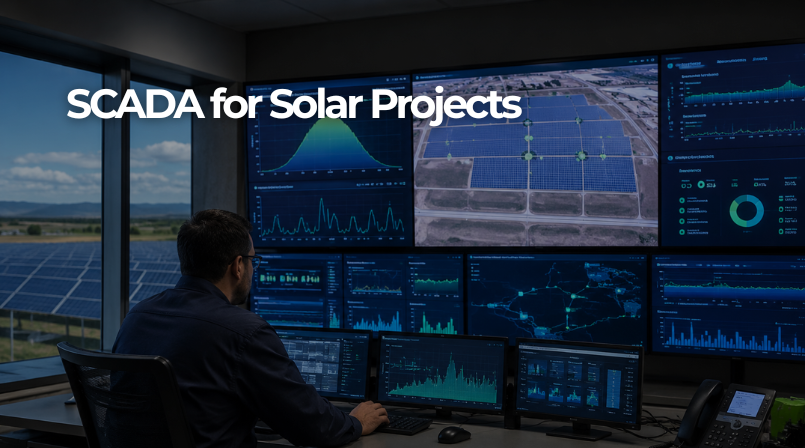
A 5kW rooftop system can get by with a phone app and a monitoring dashboard. A 50MW ground-mount plant with hundreds of inverters, combiner boxes, weather stations, and a grid interconnection point cannot. That gap is exactly what SCADA closes, and for any EPC moving from C&I-scale work into utility-scale projects, understanding SCADA for solar projects stops being optional fairly quickly.
What SCADA Actually Does on a Solar Site
SCADA, Supervisory Control and Data Acquisition, is the software and hardware layer that collects real-time data from every device across a plant, inverters, combiner boxes, weather stations, transformers, and grid metering, and presents it in one centralized system for monitoring and, where configured, remote control.
On a solar plant specifically, that means an operator sitting in a control room (or checking a dashboard remotely) can see generation output down to the individual inverter or string level, catch a fault the moment it happens rather than during a scheduled site visit, and in many configurations, remotely curtail output or respond to grid operator instructions without dispatching a technician.
Core Components of a Solar SCADA System
Data acquisition hardware gateways and communication devices (typically Modbus, RS485, or Ethernet-based) that pull data from inverters, meters, and sensors across the site
Central SCADA software the platform that aggregates all incoming data, displays it, logs historical performance, and triggers alerts
Weather stations irradiance, temperature, and wind sensors that contextualize generation data (a low output reading means something different on a cloudy day than a clear one)
Grid interconnection monitoring real-time visibility into the plant's export, frequency, and voltage at the point of interconnection, often a regulatory requirement for larger plants
Communication network the fiber, wireless, or cellular backbone connecting distributed field devices back to the central system, which needs to be planned early rather than retrofitted
Why SCADA Matters More as Projects Scale
A small C&I rooftop can rely on a manufacturer's own monitoring app, string-level detail without the need for a separate integrated system. SCADA earns its place once a project crosses into genuinely large territory, ground-mount and utility-scale sites where:
Fault response time has real financial cost an undetected inverter fault on a 500kW block can cost meaningfully more in lost generation than the same fault on a 50kW rooftop
Regulatory reporting requirements apply many state and central grid codes require real-time generation and interconnection data reporting for larger plants
Multiple equipment vendors are involved a large plant often has inverters, trackers, and protection equipment from different manufacturers, and SCADA is what unifies their data into one coherent view
Remote operation is the norm, not the exception utility-scale plants are rarely staffed around the clock on-site, making centralized remote visibility a practical necessity rather than a convenience
How Solis String Inverters Fit into a SCADA Architecture
This is where inverter choice and SCADA planning actually connect. Solis's utility-scale string inverters (as covered in our guide to Solis string inverters) are built with SolisCloud monitoring as standard, and that data can typically be integrated into a broader SCADA platform via standard communication protocols, rather than requiring a proprietary, closed system.
For EPCs specifying inverters on a project that will eventually need SCADA integration, it's worth confirming this compatibility upfront, at the tender stage, rather than discovering a data integration gap after the plant is already commissioned. Our EPC guides for the Solis 150kW and Solis 100kW inverter ranges both note SolisCloud's remote monitoring and control capabilities, which is the starting point for that SCADA conversation.
Specifying SCADA Requirements in a Tender
A few things worth locking down early in a project's BOQ or tender documentation:
Confirm which communication protocol every major device supports (Modbus TCP/RTU is the most common baseline) before finalizing equipment selection
Decide on-site vs cloud-hosted SCADA early, since this affects both network architecture and ongoing hosting costs
Specify data logging and historical retention requirements, since regulatory reporting often requires data retained for a defined period, not just live dashboards
Plan the communication backbone (fiber, wireless, or cellular) as part of civil and electrical design, not as an afterthought once equipment is already being installed
Clarify who owns ongoing SCADA software licensing and support, since this is frequently a recurring cost that gets missed in an initial project quote
Sourcing Equipment for SCADA-Ready Projects
OSG Oriana India Pvt Ltd is the authorized PAN India distributor for Solis, supplying utility-scale and C&I string inverters with SolisCloud monitoring built in, a practical starting point for any project that will eventually integrate into a broader SCADA system.
Summary
SCADA isn't a nice-to-have bolted onto a large solar project after the fact, it's infrastructure that needs planning from the equipment-selection stage onward. Choosing inverters with standard, open communication protocols and clear monitoring data access makes SCADA integration straightforward rather than a costly retrofit once the plant is already generating.
Specifying inverters or planning SCADA integration for a utility-scale project? Talk to OSG Oriana's Solis team.
FAQs
1. Do small rooftop solar systems need SCADA?
No. SCADA is generally a utility-scale and large ground-mount consideration; small residential and C&I systems are well served by a manufacturer's own monitoring app.
2. What communication protocol do most solar SCADA systems use?
Modbus (TCP or RTU) is the most common baseline protocol, though many systems also support other industrial communication standards depending on equipment vendors involved.
3. Can Solis string inverters integrate with a third-party SCADA system?
SolisCloud data can typically be integrated into a broader SCADA platform via standard communication protocols; confirm the specific integration requirements with your Solis distributor at the project planning stage.
4. When should SCADA planning start in a project
At the tender and equipment-selection stage, not after installation. Retrofitting SCADA integration onto already-installed equipment is far more complex than planning for it upfront.
5. Is SCADA hosting typically on-site or cloud-based?
Both models exist. The right choice depends on project scale, regulatory requirements, and who's responsible for ongoing software licensing and support.
Found this useful? Share it with your network.