Solis Inverters
Solis String Inverter: An EPC Guide
On this page
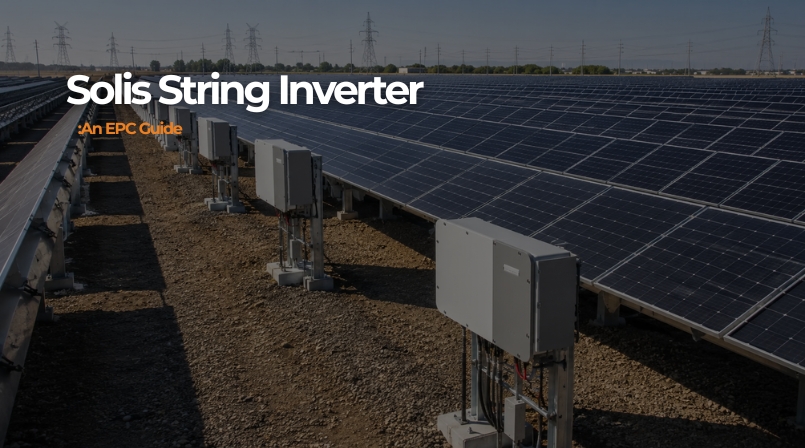
Utility-scale and large C&I projects have historically defaulted to central inverters, but the last decade has seen a genuine architectural shift, string inverters, once considered a rooftop-only technology, now compete directly at MW-scale, and increasingly win the specification. Solis has built its entire range around this shift, there is no central inverter in the Solis lineup, every product from a small residential unit to its largest utility-scale model is a Solis string inverter. This guide covers why that architecture choice matters and how to specify the right Solis string inverter for a project's scale.
What Sets a String Inverter Apart
A central inverter is a single, large unit, often housed in a container or dedicated enclosure, that aggregates DC output from hundreds of panel strings across a wide array before converting it to AC in one place. A Solis string inverter does the DC-to-AC conversion at a smaller scale, closer to the strings themselves, with multiple units distributed across a site rather than one large unit handling everything.
At small commercial and residential scale, the choice barely exists, string inverters have always dominated there. The real decision point historically sat at utility scale, ground-mount and floating plants running into tens or hundreds of megawatts, which is exactly where a high-power Solis string inverter now competes directly with legacy central architecture.
Why String Architecture Has Been Gaining Ground
The industry-wide shift toward string inverters at utility scale isn't a marketing trend, it reflects genuine operational advantages that a Solis string inverter is built around:
No single point of failure if one unit fails, the rest of the plant keeps generating; a central inverter failure can take down a much larger share of total site output
Granular MPPT tracking a distributed string inverter tracks smaller groups of panels independently, which captures more energy on sites with partial shading, soiling variance, or uneven terrain
Simpler fault isolation a string-level fault is easier to locate and repair than diagnosing an issue buried inside a large central unit
Lower structural and cooling infrastructure string inverters typically need less dedicated civil work than a central inverter's housing and cooling system
Incremental scalability a project can add or replace individual units without redesigning the entire power conversion layer
Why Every Solis Inverter Is a String Inverter
It's worth being precise here: Solis doesn't manufacture central inverters at all, there's no central inverter option anywhere in the catalog. The brand's entire range, from small residential units through its largest utility-scale models, is built on string architecture. At the top end, a high-power Solis string inverter running into the hundreds of kilowatts per unit can be deployed across a site to reach the same total plant capacity a central inverter installation would target, while keeping the operational advantages of a distributed layout.
This matters for EPCs evaluating a large project: specifying a Solis string inverter at utility scale isn't a compromise relative to central architecture, it's a deliberate choice that trades a marginally higher per-unit hardware count for meaningfully lower generation risk and easier O&M across the plant's life.
Choosing the Right Solis String Inverter for Your Project Scale
Solis's string inverter range spans every project size an EPC is likely to specify:
For residential and small commercial projects, see our guide to Solis residential inverters
For C&I on-grid projects, see our guide to Solis on-grid C&I inverters
For C&I sites needing battery backup, see our guide to Solis C&I hybrid inverters
For the full catalog, browse the Solis on-grid inverter product page directly
Sourcing for EPC Projects
OSG Oriana India Pvt Ltd is the authorized PAN India distributor for Solis, supplying the full Solis string inverter range, residential through utility-scale, with genuine manufacturer warranty support for EPCs specifying large-format projects across India.
Summary
The shift toward string architecture at utility scale has been driven by fault tolerance, MPPT granularity, and simpler O&M rather than marketing preference, and a Solis string inverter reflects that shift completely, there is no central inverter anywhere in the range. For EPCs specifying a project today, that's less a limitation and more a reflection of where the industry has already moved.
Specifying inverters for a large-scale project? Talk to OSG Oriana's Solis team, or browse the full Solis inverter range.
FAQs
1. Why has string architecture become more popular at utility scale?
Better fault tolerance (no single point of failure), more granular MPPT tracking, easier fault isolation, and lower structural/cooling infrastructure requirements compared to central inverters.
2. What's the difference between a string inverter and a central inverter?
A central inverter aggregates DC output from a large area into one big unit; a Solis string inverter converts power at a smaller scale, with multiple units distributed across a site.
3. In the string inverter vs central inverter debate, why has string become more popular at utility scale?
Better fault tolerance (no single point of failure), more granular MPPT tracking, easier fault isolation, and lower structural/cooling infrastructure requirements compared to central inverters.
4. Does Solis make central inverters?
No. There is no central inverter in the Solis lineup, every product, from residential to utility-scale, is a Solis string inverter.
5.Which Solis string inverter should I specify for a utility-scale project?
Solis's utility-scale string units are designed specifically to reach large total plant capacities; consult OSG Oriana's Solis team for the exact model matched to your project's total capacity target.
Found this useful? Share it with your network.