Solar Inverters
String Inverter vs Micro Inverter OSG Oriana India
On this page
- What Is a String Inverter?
- How it works
- Advantages
- Limitations
- What Is a Micro Inverter?
- Advantages
- Limitations
- String Inverter vs Micro Inverter: Quick Comparison
- Which Performs Better in Indian Conditions?
- Open Rooftops
- Shaded Rooftops
- Cost Comparison
- String Inverter System
- Micro Inverter System
- Maintenance and Reliability
- String Inverter
- Micro Inverter
- Best Choice for Different Users
- Choose a String Inverter if:
- Choose a Micro Inverter if:
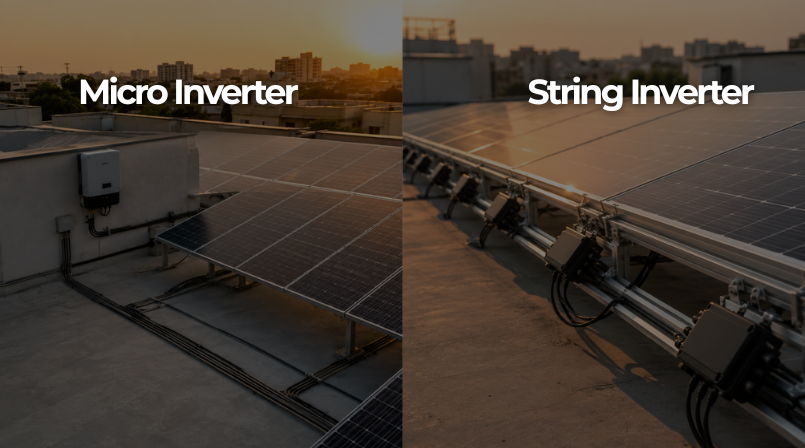
When investing in a solar power system, most people focus on solar panels, but the inverter is equally important. It converts the DC electricity produced by solar panels into AC electricity used by homes and businesses.
The two most common technologies are String Inverters and Micro Inverters. Choosing the wrong one can affect your energy generation, maintenance cost, and long-term return on investment.
In this guide, OSG Oriana India explains the difference between String Inverters and Micro Inverters and helps you decide which is best for Indian rooftop and commercial solar installations.
For high-performance on-grid solutions, explore Solis On-Grid Inverters
What Is a String Inverter?
A String Inverter connects multiple solar panels in a series, called a string, to a single inverter.
How it works
Several panels are wired together.
The combined DC power flows to one central inverter.
The inverter converts the total power into usable AC electricity.
Advantages
Lower installation cost
Simple design
Easy servicing from a single location
Ideal for large residential and commercial rooftops
Limitations
If one panel in the string is heavily shaded, dirty, or underperforming, the output of the entire string can decrease.
This is why proper panel orientation, spacing, and maintenance are important in string-based systems.
What Is a Micro Inverter?
A Micro Inverter is installed behind each individual solar panel.
Instead of one central inverter handling all panels, every panel converts its own DC power into AC power independently.
Advantages
Better performance under partial shading
Independent panel operation
Panel-level monitoring
Easier future expansion
Limitations
Higher upfront cost
More electronic components on the roof
Replacement can be more time-consuming because the unit is mounted behind the panel
String Inverter vs Micro Inverter: Quick Comparison
Feature | String Inverter | Micro Inverter |
|---|---|---|
Initial Cost | Lower | Higher |
Installation Complexity | Simple | Moderate |
Shading Performance | Moderate | Excellent |
Monitoring | System-level | Panel-level |
Maintenance Access | Easy | Roof access required |
Best For | Large open rooftops | Complex or shaded rooftops |
Which Performs Better in Indian Conditions?
Open Rooftops
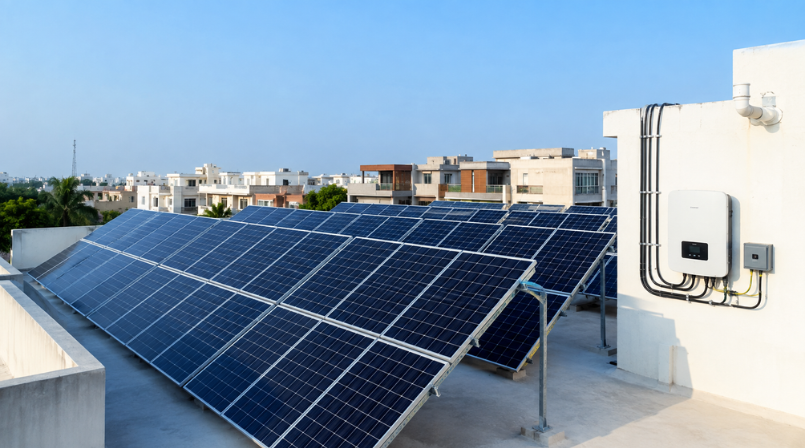
For most Indian homes and commercial buildings with unshaded rooftops, String Inverters generally provide the best value.
Modern inverters such as Solis On-Grid Inverters offer:
High conversion efficiency
Multiple MPPTs
Wide input voltage range
Remote monitoring support
Reliable performance in high-temperature conditions
These features make them suitable for residential, commercial, and industrial rooftop projects.
Shaded Rooftops
If your roof has:
Water tanks
Nearby buildings
Trees
Different roof orientations (east-west + south)
then Micro Inverters can produce higher energy output because each panel operates independently.
Cost Comparison
For a typical 5 kW residential system:
String Inverter System
Lower equipment cost
Lower installation labor
Faster payback period
Micro Inverter System
20–40% higher upfront investment
Better energy harvest in challenging roof conditions
Higher long-term value only when shading losses are significant
In most Indian cities, a String Inverter system usually offers the better cost-to-performance ratio.
Maintenance and Reliability
String Inverter
One inverter to inspect
Easier troubleshooting
Lower maintenance effort
Widely available service support
Micro Inverter
Failure of one unit affects only one panel
Requires roof-level access for replacement
Larger number of electronic components increases overall system complexity
For EPC contractors and commercial operators, centralized maintenance is often a major advantage of String Inverter systems.
Best Choice for Different Users
Choose a String Inverter if:
Your roof receives uniform sunlight
All panels face the same direction
You want lower upfront cost
You are installing 5 kW to several hundred kW systems
You prefer simpler maintenance
Choose a Micro Inverter if:
Your roof has frequent shading
Panels must face multiple directions
You want panel-level performance monitoring
Future expansion is a priority
Why Many EPC Companies Prefer String Inverters
Professional solar EPC companies often recommend String Inverters because they provide:
Better economics for most projects
Faster installation
Proven long-term reliability
Easier inventory management
Simplified after-sales support
OSG Oriana India supplies Solis On-Grid Inverters, which are designed for high-efficiency solar installations across residential, commercial, and industrial applications.
Summary
The String Inverter vs Micro Inverter debate does not have a universal winner.
For most Indian rooftop and commercial solar projects: String Inverter is the smarter and more economical choice.
For shaded, complex, or multi-directional rooftops: Micro Inverter can deliver better energy generation despite the higher initial cost.
Before making a decision, evaluate:
Roof shading throughout the day
Number of panel orientations
System size
Maintenance accessibility
Long-term return on investment
A properly designed inverter solution can improve solar generation, reduce electricity bills, and maximize the value of your solar investment for the next 20–25 years.
For expert guidance and high-performance Solis On-Grid Inverters, contact OSG Oriana India and choose the inverter technology that best matches your rooftop conditions and energy goals.
FAQs
1: Which is better for a home solar system: String Inverter or Micro Inverter?
String Inverter is usually the better choice because it is more affordable, easier to maintain, and highly efficient. A Micro Inverter is a better option if your roof has partial shading, multiple roof directions, or space constraints.
2: Do Micro Inverters generate more electricity than String Inverters?
Micro Inverters can generate more electricity in shaded or complex rooftop conditions because each panel works independently. However, on a uniform rooftop with full sunlight, the difference in energy production is often very small, making a modern String Inverter more cost-effective for most installations.
3: Are String Inverters reliable for commercial solar projects in India?
Yes. String Inverters are widely used in residential, commercial, and industrial solar projects across India because they offer high efficiency, centralized monitoring, simpler maintenance, and lower system costs. Solutions such as Solis On-Grid Inverters supplied by OSG Oriana India are designed for reliable long-term performance in Indian operating conditions.
Found this useful? Share it with your network.