Solar inverters
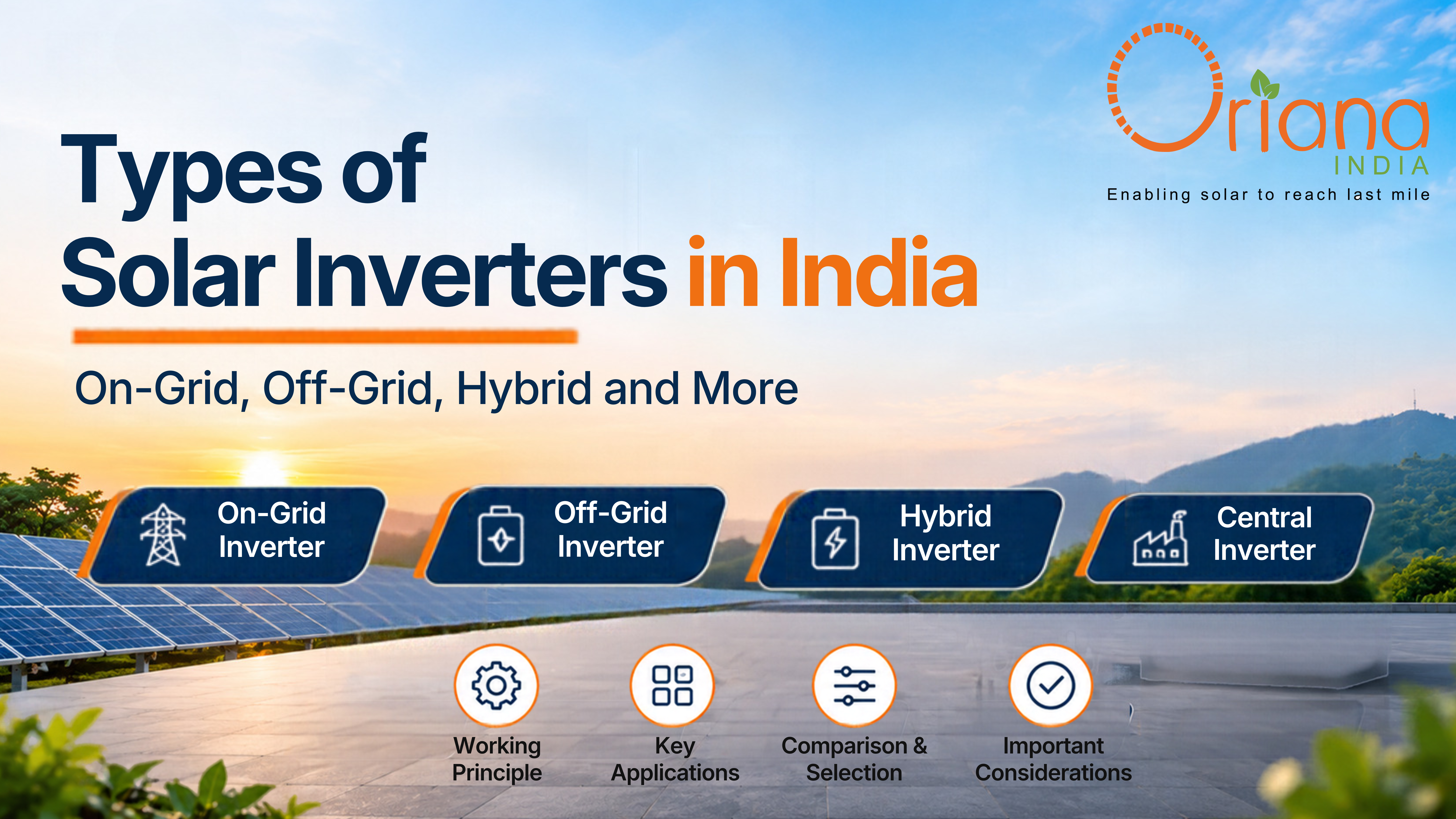
Types of Solar Inverters in India: On-Grid, Off-Grid, Hybrid and More
Introduction
Solar energy is becoming an increasingly important part of India's renewable energy landscape. From residential rooftops to commercial buildings, factories and large-scale solar power plants, different types of solar systems are being installed to meet growing energy requirements.
One of the most important components of any solar power system is the solar inverter.
A solar inverter converts the direct current (DC) electricity generated by solar panels into alternating current (AC) electricity that can be used by electrical appliances and equipment.
However, not all solar inverters are designed for the same applications. Some work with the electricity grid, some operate with battery storage, while others are designed for large commercial and utility-scale projects.
In this guide, we explore the major types of solar inverters, their working principles, applications and important selection factors.
1. What Is a Solar Inverter?
A solar inverter is an essential component of a solar power system. Solar panels generate DC electricity when exposed to sunlight, but most electrical appliances and commercial power systems operate using AC electricity.
The inverter performs this conversion and may also provide functions such as system monitoring, protection, grid interaction and power management, depending on its design.
The right inverter depends on the type of solar installation, energy requirements, grid availability, battery requirements and project capacity.
2. Different Types of Solar Inverters
Solar inverters can be classified according to their system configuration and technology.
The major categories include:
On-grid solar inverters
Off-grid solar inverters
Hybrid solar inverters
String solar inverters
Central solar inverters
It is important to understand that these categories are not all mutually exclusive. For example, a string inverter describes an inverter architecture, while on-grid and hybrid describe system configurations.
3. On-Grid Solar Inverters
An on-grid solar inverter is designed to operate in a solar power system connected to the electricity grid.
It converts DC electricity from solar panels into AC electricity and synchronises its output with the grid.
How Does an On-Grid Inverter Work?
Solar panels generate DC electricity.
The inverter receives DC power from the solar array.
The inverter converts DC electricity into AC electricity.
The generated power supplies connected electrical loads.
Depending on the system configuration and applicable regulations, surplus electricity may be exported to the grid.
Key Features
Designed for grid-connected solar systems.
Converts solar DC power into grid-compatible AC power.
Can support system monitoring.
Commonly used in residential, commercial and industrial rooftop installations.
Applications
Residential rooftop solar systems.
Commercial buildings.
Industrial rooftops.
Grid-connected solar projects.
Important: A standard grid-following on-grid inverter generally shuts down during a grid outage for anti-islanding safety. It should not be assumed to provide backup power unless the system has a suitable backup configuration.
4. Off-Grid Solar Inverters
An off-grid solar inverter is designed for solar power systems that operate independently of the electricity grid.
These systems commonly use battery storage to supply electricity when solar generation is unavailable or insufficient.
How Does an Off-Grid Inverter Work?
Solar panels generate DC electricity.
The system uses solar energy to supply loads and charge batteries, depending on its configuration.
Stored battery energy can be converted into AC electricity when required.
The system supplies electricity independently of the utility grid.
Key Features
Designed for independent operation.
Commonly works with battery storage.
Suitable for locations without reliable grid access.
System design depends on load requirements and battery capacity.
Applications
Remote locations.
Rural installations.
Off-grid homes and facilities.
Sites with limited or unreliable grid access.
5. Hybrid Solar Inverters
A hybrid solar inverter is designed to work with solar generation, the electricity grid and compatible battery storage.
It offers greater flexibility in managing solar power, grid electricity and stored energy.
How Does a Hybrid Inverter Work?
Solar panels generate DC electricity.
The inverter manages the available solar energy.
Solar power can supply connected loads.
Compatible battery systems can be charged when conditions allow.
Stored energy can be used according to the system settings and operating conditions.
Grid electricity may be used when solar and battery power are insufficient.
Key Features
Supports solar and compatible battery integration.
Can manage multiple energy sources.
May support backup operation when designed and configured for it.
Offers energy management flexibility.
Applications
Residential solar systems with battery storage.
Commercial installations requiring backup capability.
Facilities interested in energy management.
Projects with specific grid and storage requirements.
Important: Battery compatibility, backup output, operating modes and supported battery capacities vary by inverter model. Always check the manufacturer's datasheet.
6. String Solar Inverters
A string inverter is a common inverter architecture in which multiple solar modules are electrically connected in series to form strings.
The inverter converts the DC electricity received from these strings into AC electricity.
Key Features
Multiple solar modules can be connected in strings.
Multiple MPPT inputs may be available depending on the model.
Suitable for different rooftop and ground-mounted applications.
Monitoring and protection features vary by product.
Applications
Residential rooftop projects.
Commercial and industrial installations.
Large rooftop solar plants.
Selected ground-mounted solar projects.
The number of strings, MPPT inputs, voltage limits and current limits should be evaluated during system design.
7. Central Solar Inverters
Central inverters are designed for larger solar power installations.
In these systems, DC power from multiple solar array sections is collected and supplied to a central inverter or inverter system for conversion into AC power.
Key Features
Designed for large-scale solar applications.
Handles high power capacities.
Used in large ground-mounted solar plants.
Requires appropriate electrical infrastructure and system planning.
Applications
Utility-scale solar parks.
Large ground-mounted projects.
Large renewable energy installations.
The choice between central and string inverter architectures depends on project size, layout, operating requirements, system design and maintenance strategy.
8. Comparison of Different Solar Inverter Types
Inverter Type | Grid Connection | Battery Integration | Common Applications |
|---|---|---|---|
Yes | Not inherent | Rooftop and grid-connected projects | |
No | Commonly used | Remote and independent systems | |
Yes, depending on design | Supported | Solar and storage applications | |
String | Depends on system design | Depends on model | Rooftop and commercial projects |
Central | Usually grid-connected | Depends on system design | Large solar plants |
9. How to Choose the Right Solar Inverter?
Selecting the correct solar inverter requires an understanding of project requirements.
1. Understand the Project Type
Identify whether the installation is residential, commercial, industrial or utility-scale.
2. Check the Required Capacity
Evaluate the solar array capacity, expected load, inverter output capacity and proposed DC-to-AC ratio.
3. Evaluate Grid Availability
Determine whether the project is connected to the electricity grid or requires independent operation.
4. Consider Battery Requirements
If battery storage or backup operation is required, select an inverter designed to support the intended battery configuration.
5. Review Technical Specifications
Check the following parameters:
Maximum DC input voltage.
MPPT voltage range.
Maximum input current.
Number of MPPTs.
AC output voltage.
Rated output power.
Efficiency.
Protection features.
Communication and monitoring options.
6. Check Warranty and Technical Support
Evaluate warranty conditions, product documentation, service availability and manufacturer or distributor support.
7. Evaluate Site Conditions
Consider ambient temperature, dust, moisture, installation location, ventilation and applicable environmental protection ratings.
10. Why Product Selection Matters for EPC Companies and Installers
For EPC companies and installers, inverter selection affects more than the equipment purchase.
The right inverter must match the solar array design, electrical infrastructure, operating conditions and customer requirements.
Before finalising a product, project teams should:
Review the inverter datasheet.
Verify module and string compatibility.
Check voltage and current limits.
Confirm grid and battery compatibility.
Evaluate monitoring and communication options.
Review installation and commissioning requirements.
Understand warranty and service conditions.
A well-planned inverter selection process can help EPC teams improve project execution and avoid avoidable design mismatches.
Conclusion
Different types of solar inverters serve different purposes in the solar energy ecosystem.
On-grid inverters are designed for grid-connected installations, off-grid inverters support independent solar systems, and hybrid inverters combine solar generation with grid and battery integration. String and central inverters describe different architectures used across rooftop, commercial and large-scale solar projects.
Understanding these differences helps homeowners, installers, EPC companies and project developers make informed equipment decisions.
OSG Oriana India offers solar product solutions for the evolving solar market. Explore our product range and connect with our team to discuss your project requirements.
FAQs
What are the main types of solar inverters?
The main system configurations include on-grid, off-grid and hybrid inverters. String and central inverters are also common inverter architectures.
What is the difference between on-grid and off-grid solar inverters?
On-grid inverters operate with the electricity grid, while off-grid inverters are designed to operate independently and commonly use battery storage.
What is a hybrid solar inverter?
A hybrid solar inverter is designed to manage solar generation, grid electricity and compatible battery storage within one system.
Which solar inverter is suitable for commercial projects?
The selection depends on project capacity, grid connection, solar array design, site conditions, monitoring requirements and operating needs.
What is the difference between string and central inverters?
String inverters typically handle power from individual PV strings or groups of strings, while central inverters collect power from larger sections of a solar array for centralised conversion.
Can an on-grid solar inverter work during a power cut?
A standard grid-following on-grid inverter generally shuts down during a grid outage for safety. Backup operation requires a suitable inverter and system configuration.
Found this useful? Share it with your network.