Solar Inverters
Why Solar Inverters Fail
On this page
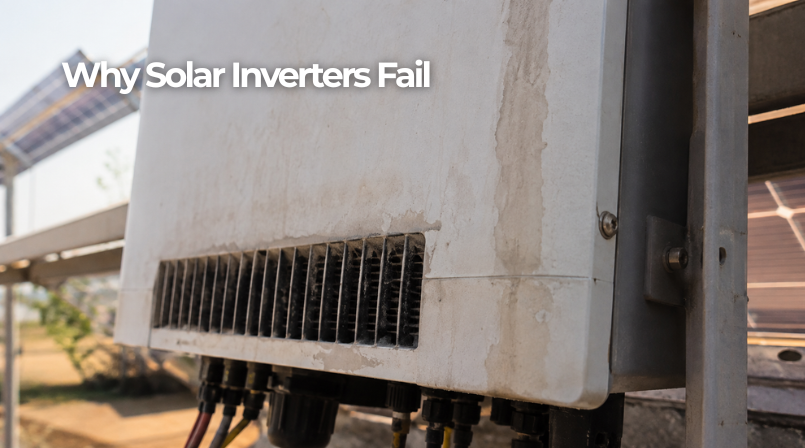
An inverter is the one part of a solar system with real electronics doing real work every single day it's sunny. Panels can sit passively for 25 years; inverters can't. That's exactly why inverter failure, not panel degradation, is the most common reason a solar system needs an unplanned service call. Here's what actually causes it, and why failure rates vary so much between brands.
Thermal Stress Is the Number One Killer
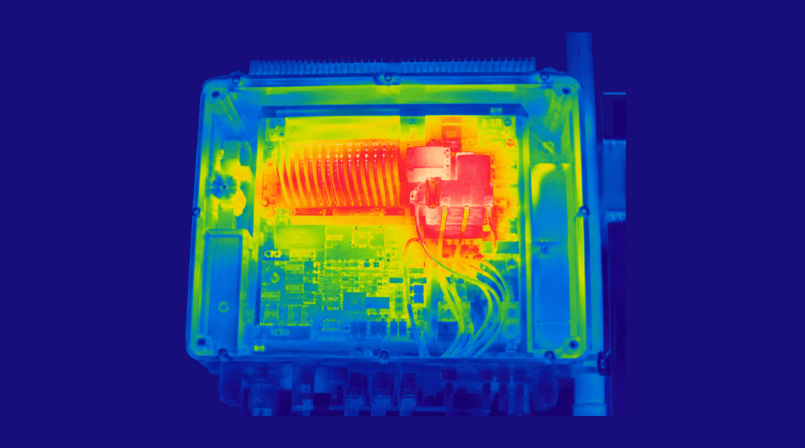
Heat is the single biggest driver of inverter failure. Every inverter generates heat while converting DC to AC, and if that heat isn't managed properly, internal components, especially capacitors and power semiconductors, degrade faster than they should. Poor ventilation clearance, direct sun exposure, and inadequate cooling design all accelerate this. In India, where ambient temperatures regularly hit 40°C-plus in summer, thermal stress is a bigger factor than in cooler climates, which is exactly why cooling design isn't a minor spec, it's one of the most important ones.
Dust and Moisture Ingress
Inverters are electronics housed in a box that lives outdoors. Any gap in that housing's sealing lets dust or moisture in over time, and once inside, both accelerate corrosion and can cause short circuits. This is a bigger problem than most buyers expect, particularly in dusty regions or during monsoon season, and it's directly tied to an inverter's IP (ingress protection) rating, a spec that's easy to skip past on a datasheet but has a real, measurable effect on failure rates.
Component Wear, Especially Fans and Capacitors
Traditional inverter designs rely on cooling fans, and fans are mechanical parts that wear out. A failing fan doesn't just get noisy, it directly causes the thermal stress problem above, since cooling capacity drops right when the unit needs it most. Capacitors, the components that smooth and regulate power internally, also have a finite working life and are one of the most common points of failure across the industry, regardless of brand.
Grid Fluctuations and Electrical Surges
Voltage spikes, frequency fluctuations, and lightning-induced surges all put stress on an inverter's internal protection circuitry. An inverter without adequate surge protection absorbs more of that stress directly into its sensitive components, shortening working life even if it doesn't cause an immediate failure.
Installation Quality
A genuinely well-built inverter can still fail early if it's installed poorly, incorrect grounding, inadequate ventilation clearance, or a mounting location exposed to rain despite the unit's rating can all cause problems unrelated to the manufacturer.
Manufacturing Defects and Inconsistent Quality Control
Not every inverter coming off a production line is identical, and manufacturers with weaker quality control ship more units with latent defects that surface as early failures. This is where brand and manufacturing scale matter, not as a marketing point, but because rigorous testing catches problems before a unit reaches a project site.
Why Solis Sees Meaningfully Lower Failure Rates
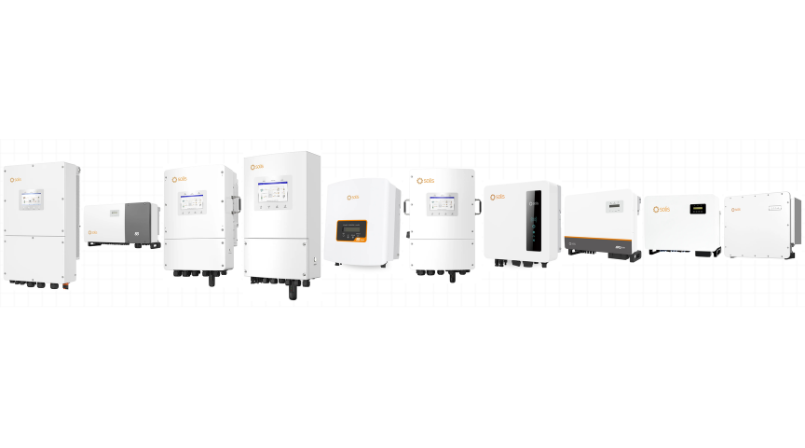
Every cause above is a known, industry-wide risk. What separates Solis is that its design and manufacturing process target each one directly rather than treating failure as inevitable:
Sub-0.3% reported failure rate, with a reliability rate of approximately 99.7%, notably low for a component with 25-year field exposure
Fanless design on residential units, removing one of the most common mechanical wear points entirely rather than managing around it
IP66 protection on current models, directly addressing the dust and moisture ingress problem rather than leaving it to installation conditions alone
Anti-PID technology, protecting connected panels from a degradation pathway that shows up as system-level performance loss even when the inverter itself hasn't failed
AFCI (arc fault) protection, catching a developing electrical fault before it escalates into a failure or fire risk
Rigorous third-party reliability testing, Solis was among the first inverter brands to pass DNV-GL (now PVEL) reliability testing, the kind of independent validation that catches manufacturing and design weaknesses before they reach the field
None of this means a Solis inverter is immune to failure, no electronic component is. But the design choices are specifically aimed at the actual, documented causes of inverter failure across the industry, not generic marketing claims layered on top of a standard product.
Conclusion
Most inverter failures trace back to heat, moisture, component wear, electrical stress, or installation quality, causes that are well understood and, to a real degree, preventable through design. A brand's reported failure rate is a reasonable proxy for how seriously it takes those causes, and it's worth checking before price becomes the only factor in a buying decision.
Want to source a reliable Solis inverter for your project? Get in touch with OSG Oriana's team, or browse the full Solis inverter range.
FAQs
1. What's the most common cause of solar inverter failure?
Thermal stress, heat accumulation from poor cooling design or inadequate ventilation degrades internal components faster than normal operation would.
2. Does a lower failure rate mean an inverter never fails?
No. It means failures are less frequent statistically, not impossible. Every electronic component carries some failure risk over a 25-year system life.
3. Why does Solis report a lower failure rate than many competitors?
Design choices like fanless construction, IP66 protection, anti-PID technology, and third-party reliability testing directly target the industry's most common failure causes rather than leaving them unaddressed.
Found this useful? Share it with your network.